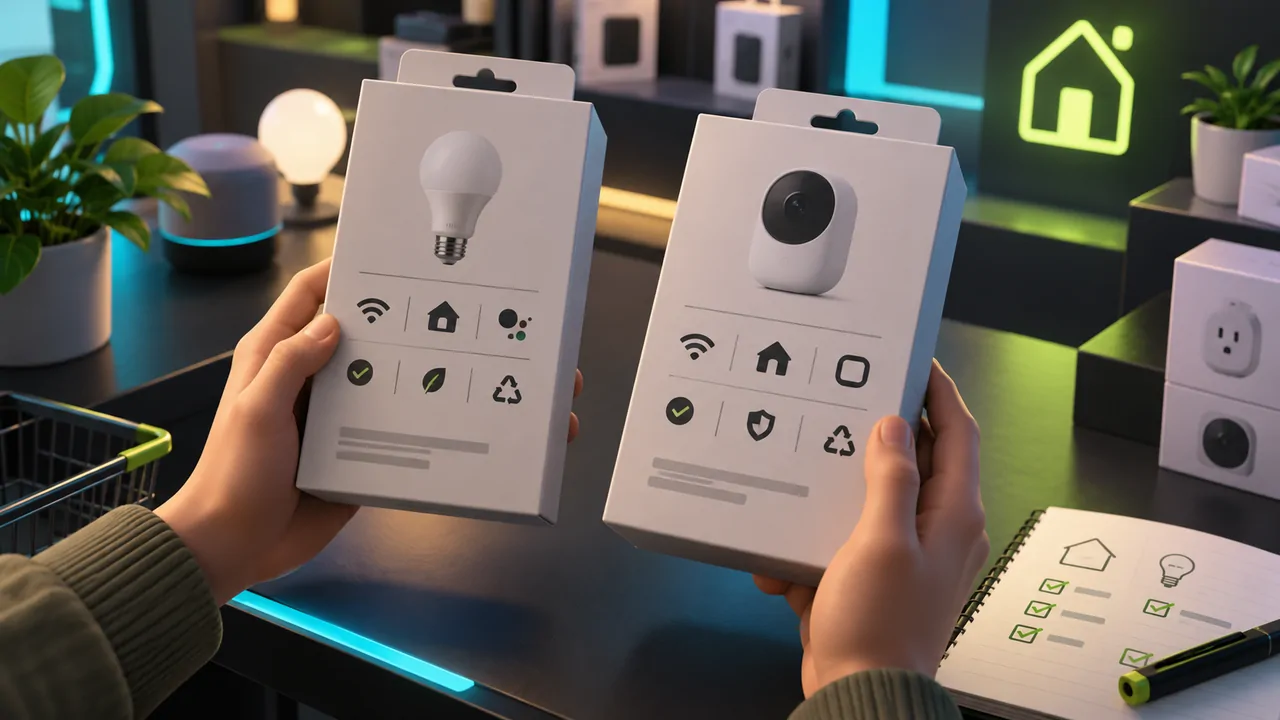
How to Read Smart-Home Compatibility Labels Before You Buy is not a product ranking and it is not a promise that one standard or device will solve every household problem. It is a decision guide for readers who want to make a compatibility label in a way that remains understandable six months later. The useful starting point is the exact function you expect after setup. That turns a vague shopping or setup question into something that can be observed, discussed with other household members, and revised without replacing an entire system.
For How to Read Smart-Home Compatibility Labels Before You Buy, the standards context matters, but it should not replace checking the documentation for the exact product and ecosystem in front of you. Connectivity Standards Alliance: Build With Matter ↗ describes the capabilities and scope behind this subject. Read that material as a foundation, then compare it with the manufacturer’s current compatibility and support information. A label can describe a supported path; it does not automatically describe every setting, automation, or optional service that appears in every app.
Begin How to Read Smart-Home Compatibility Labels Before You Buy by writing down the smallest outcome you want. For a compatibility label, name the room or system, the person who depends on it, the normal action, and the unwanted outcome you are trying to avoid. This prevents a common failure mode: expanding a project because a dashboard makes many choices visible. A short note such as “the hall light should be easy to control manually and should not wake anyone at night” is more useful than a list of features.
Make the decision visible
For How to Read Smart-Home Compatibility Labels Before You Buy, use a one-page record with four headings: purpose, owner, dependencies, and recovery. Under purpose, describe the household benefit in plain language. Under owner, record the account or controller that can change the setting. Under dependencies, list power, network, app, hub, and subscription requirements. Under recovery, record how to return to an ordinary manual state. Pay particular attention to certification, supported ecosystems, and limits stated in product documentation. A record is not bureaucracy; it is what lets another person understand the system without guessing.
When testing How to Read Smart-Home Compatibility Labels Before You Buy, test the normal path before you create automation around it. Confirm that the intended action works from the location where it will be used, at the time it will be used, and by the person who will rely on it. If a device needs a controller, make that dependency explicit. If a setting is only available in one vendor app, write that down rather than assuming it will appear everywhere. Test a manual control after testing an app control. This keeps the project useful when phones change, guests arrive, or an internet service has an interruption.
Use a small pilot
For How to Read Smart-Home Compatibility Labels Before You Buy, keep the first version deliberately narrow. Change one rule, live with it for several days, and keep a brief note about surprises. Look for false triggers, confusing notifications, unwanted timing, and steps that a household member cannot repeat. Do not interpret a quiet first day as proof that the design is finished. A useful pilot asks whether the new behavior is clearer and less burdensome than the old one. If the answer is no, remove or simplify it. Reversibility is a feature, not a failure.
If How to Read Smart-Home Compatibility Labels Before You Buy does not work as expected, diagnose the layer instead of repeating setup at random. Check power and physical controls first. Next check the local network and the relevant controller. Then check account access, permissions, and automation logic. Note what you observed at each step. This method keeps a temporary failure from turning into an unexplained collection of resets. It also makes vendor support more useful because you can describe the condition, action, and result.
Decide what not to automate
How to Read Smart-Home Compatibility Labels Before You Buy does not require automating every repeat action. Avoid automating choices that are sensitive to visitors, sleep, accessibility needs, maintenance work, or a homeowner’s preference on a particular day. A visible switch, a predictable schedule, or a written reminder can sometimes be the better tool. The aim is not maximum automation; it is a home that remains legible to the people who live in it. That principle is especially valuable when evaluating a compatibility label.
As you maintain How to Read Smart-Home Compatibility Labels Before You Buy, revisit the record after a new phone, new router, move, household change, or vendor update. Remove access that is no longer needed and correct notes that have become inaccurate. The sources below support the standards or security context for this guide, but they are not substitutes for a product manual, qualified installer, or local requirements. When a change affects heating, electrical work, locks, alarms, or another consequential system, pause and use appropriate professional guidance.
A final note for How to Read Smart-Home Compatibility Labels Before You Buy: keep the decision small enough to explain in two sentences to another person. If the explanation needs a long apology, several hidden settings, or a promise that nobody may touch the system, simplify the design. A connected home earns trust through predictable behavior, visible ownership, and a recovery path that does not depend on one person remembering every detail.